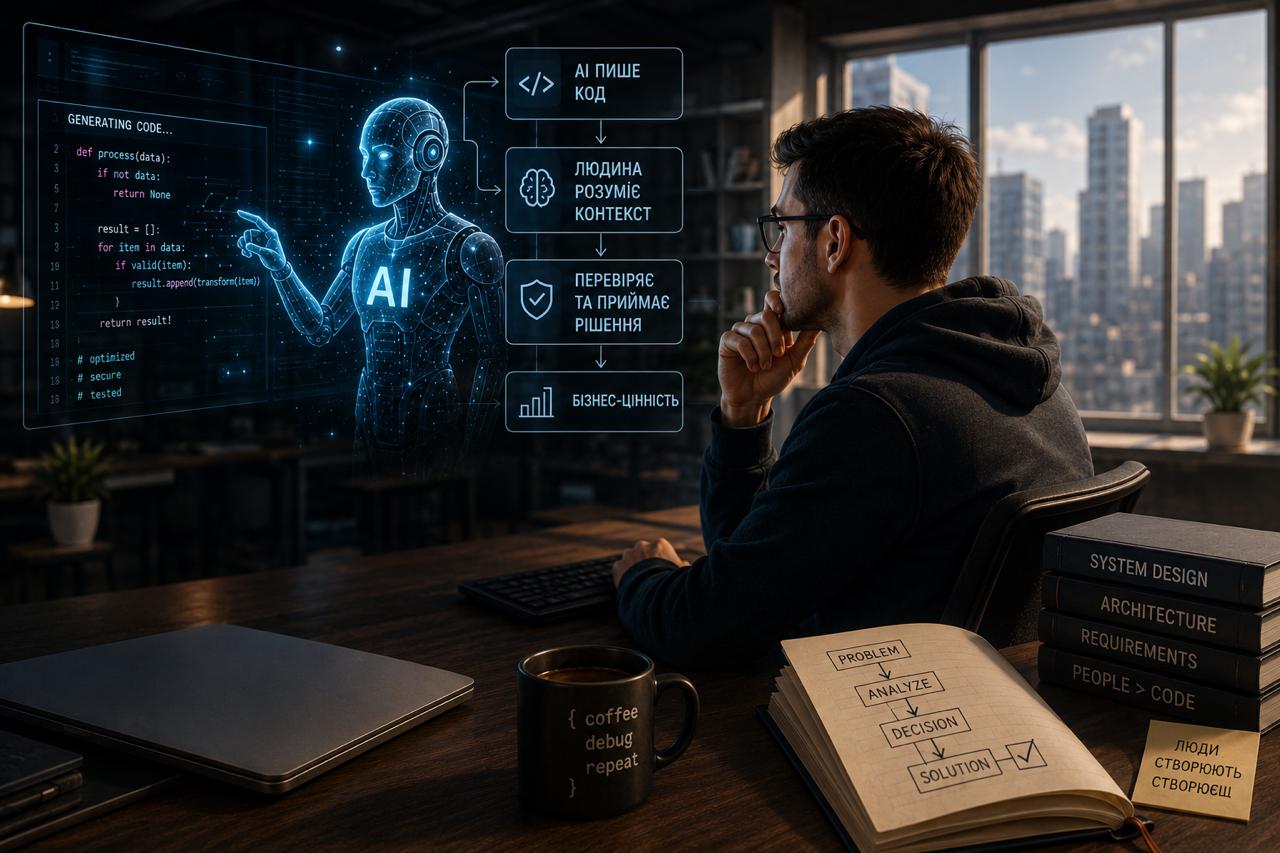
 Let me clarify what I'm actually talking about first, because this topic gets muddled easily. "IT" is a huge field: QA, analysts, designers, DevOps, project managers. I'm specifically talking about writing code - about developers, meaning people whose job is turning a task into working code. That's narrower than "IT in general," and it's exactly where AI is hitting hardest.
And I'll say it plainly: I think we're approaching the point where developers essentially stop writing code by hand. If not by the end of 2026, then definitely by early 2027. I'm judging by myself - right now AI writes 90%, and on some projects 100%, of my code. Honestly, I don't even remember the last time I wrote something from scratch instead of editing and steering what AI already wrote.
It's not just my own feeling
About a month ago I saw a clip from an internal xAI meeting where Elon Musk said something very similar, only more radical. According to him, by the end of 2026 you won't even need to write code - AI will generate a finished binary directly, skipping both the programming language and the compiler. His argument is simple: AI can already produce a more efficient binary than any compiler.
I agree with that. Not in the sense that I literally believe in "skipping the compiler" - there's room to argue the technical details there. But in the sense that writing code by hand as a daily job is already disappearing fast. And it'll keep disappearing even faster.
Jensen Huang sees it differently
Around the same time, an interview with Nvidia CEO Jensen Huang for CNA came out, telling a completely different story - not about the profession disappearing, but about it transforming, and addressing the layoffs-blamed-on-AI narrative head-on.
Huang came down fairly hard on companies that explain their layoffs as AI-driven. He called that narrative "too lazy" - his argument being that AI only became genuinely productive around six months ago, so how could companies have been laying people off because of it two years earlier. In his view, some executives just want to sound modern and "smart" by hiding behind AI, when the real reasons for the cuts are older and less comfortable - and he called the practice irresponsible, since it just scares people.
His advice to workers is pretty direct: you won't lose your job to AI, you'll lose it to someone who learned to use AI better than you. And here he draws his own historical parallel, similar to the one I'll describe below - according to him, over the last 300, 100, 60 years, even through the computer era, both employment and productivity ultimately kept growing despite every technological wave.
Here's what I think about this: Huang isn't actually denying the transformation itself - he's denying the convenient excuse built on top of it. That's an important distinction. He's not saying "AI won't change anything," he's saying "don't blame AI for what's really about management decisions and economic cycles." And I partly agree - a chunk of the 2024-2025 layoffs probably had little to do with AI's real capabilities at the time. But that's also where his argument has a weak spot: the fact that AI couldn't replace a junior a year ago doesn't mean that now, when it genuinely can, companies won't start doing exactly that at scale. Yesterday's lazy narrative doesn't make today's reality any less real.
History has already been through something like this
It's worth remembering that humanity has gone through similar transformations before - and each time, the profession didn't vanish without a trace, it turned into something else.
Take writing. Texts used to be copied by hand, letter by letter, and there were people whose entire profession was copying - scribes. It was slow, grueling work. Then the typewriter showed up - the first commercially successful model came out in the 1870s. And something interesting happened: scribes as a profession basically disappeared, but a whole new industry appeared - typists, and it gave work to thousands of people, mostly women, for whom office work had previously been almost inaccessible. Then computers arrived, and typewriters as a work tool nearly vanished from offices too, giving way to the keyboard. Each step - a new wave of jobs disappearing and new ones appearing that hadn't existed before.
Same story in factories. Everything used to be assembled by hand - part by part. Then came electricity and the assembly line, which enabled mass production - that was already the second industrial revolution. And starting in the 1960s, the first industrial robots showed up on factory floors, taking over repetitive, heavy, and dangerous work. People didn't disappear in the process - they moved from the role of "the one who assembles the part by hand" to the role of "the one who maintains, programs, and oversees the robot that assembles the part." A modern factory worker is more likely to be holding a tablet than a wrench.
The pattern in all these examples is the same: technology takes away a specific task, not the profession as such. The scribe didn't turn into a typist instantly and painlessly - for some, it really was the end of a career. But overall, on the scale of a generation, people didn't disappear from the labor market - they moved to where humans were still needed: oversight, maintenance, decision-making, creativity. I think something very similar is going to happen with development. Writing code by hand, like a scribe's copying or manual part assembly, will disappear as the main daily activity. But that doesn't mean the profession disappears entirely - it means another shift into something else.
What's actually happening in the job market
Now some numbers, without the emotion. Unemployment among recent computer engineering graduates in the US is 7.5%, computer science graduates 6.1%. That's noticeably higher than the country's overall unemployment rate (4.3%) and even higher than graduates in nursing or art history. A survey of 1,000 US business leaders found that six out of ten companies are likely to lay off workers in 2026, and four out of ten plan to replace some employees with AI.
The number of entry-level job postings really has dropped sharply: according to Indeed data via FRED, developer job postings are down roughly 35% from pre-pandemic levels and about 70% below the 2022 peak.
But the market hasn't sunk evenly - it split in two. Some companies are cutting junior positions hard for speed right now. Others, big corporations, are actually hiring more juniors, because they're thinking on a ten-year horizon, not the next year and a half.
My personal take
Developers as a profession won't disappear entirely. But I think AI will partially replace juniors specifically, while seniors aren't just safe - they're becoming even more valuable. The reason is simple: when AI writes almost all the code, the main value a human brings shifts to verification and judgment - whether what AI produced actually makes sense in the context of the whole system. That's a skill built over years, you don't get it right after a bootcamp or a degree.
Experienced developers are now spending 19% more time on code review than before tools like Copilot showed up. At one company that rolled out AI to 300 engineers, the volume of code shipped to production grew by 28%, with 30-40% of that code AI-generated. Someone has to check all of that - and not every junior can, because that takes experience a junior, by definition, doesn't have yet.
What a junior should do right now
Build up debugging skills, not just writing code from scratch. This is probably the most underrated skill in the field. Plenty of people can write code, far fewer can quickly fix something that's broken. AI still isn't great at this specifically, because it requires understanding context, not just generating text.
Think it through yourself first, then check with AI. Write the code yourself, work out the logic in your own head - then check it against AI, ask it to critique or explain. One study found something telling: juniors who leaned on AI from the start finished tasks faster but understood the material worse - 17% lower scores on comprehension tests. Speed without understanding is just an illusion of progress.
Learn to explain "why," not just "what." In interviews these days, a lot more weight goes to whether you can catch an AI mistake and explain the tradeoff, rather than how fast you can write code.
Don't underestimate "soft" skills - they're your edge. Being able to explain a technical decision in plain language, run a clear postmortem, push back on product requirements with solid reasoning - AI still isn't good at any of that.
Is it even worth going into an IT degree right now
I don't have a clean answer here, and I'll be honest about why. IT is changing so fast right now that four years of studying is a massive stretch of time when even the past single year already changed everything dramatically. What happens to the curriculum, which skills stay relevant over four years - that's a big open question with no answer. You might start studying one thing and graduate into an industry that works completely differently.
If you're going into IT because it's "easy money and a low barrier to entry" - that motivation is already about five years out of date. If you're going because you're genuinely curious how systems work, and you want to understand architecture rather than just assemble things from tutorials - then it's probably worth it. Just go in understanding the path will be longer and harder than it was a few years ago.
Bottom line
I think we're on the verge of a moment when writing code by hand stops being a developer's main job - Musk's statement, my own practice (where AI already writes 90-100% of my code), and even the entire history of technological transformation all point that way. Huang isn't denying the transformation itself, he's denying the convenient excuse built on top of it - and there's something to that, but it doesn't cancel out what's actually happening. I mainly see this as a serious challenge for people just entering the field. Whoever invests now in debugging, judgment, understanding systems, and explaining decisions will end up in a far stronger position than someone who can only write code. AI will be able to write that code itself soon enough, without a single person at the keyboard.