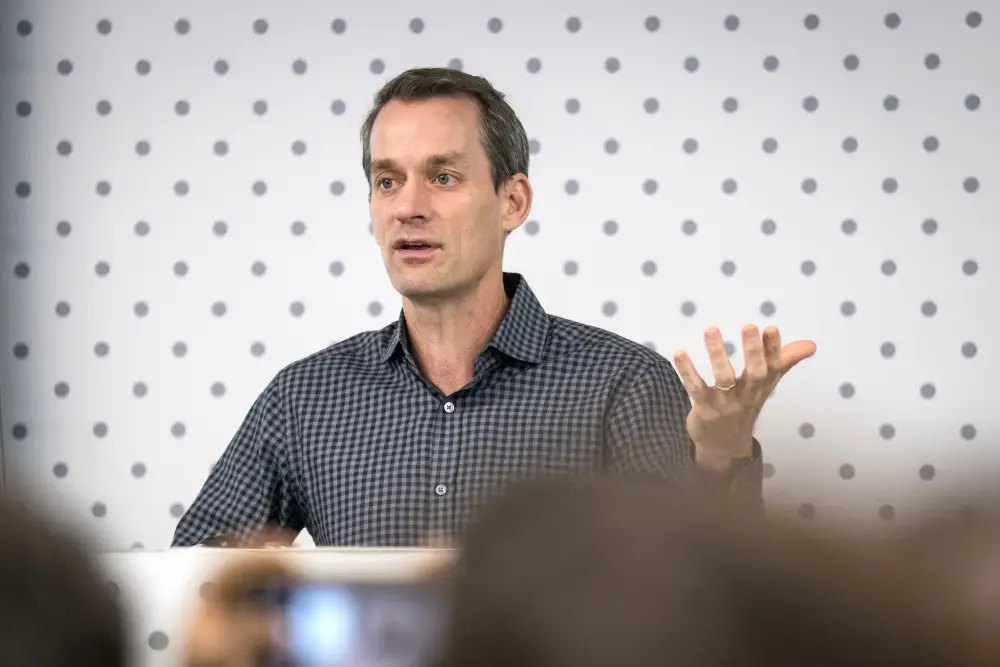
There's a telling story from 2023: right after Google unveiled its first Gemini chatbot to compete with ChatGPT, Jeff Dean went to an AI conference and was instantly swarmed by people wanting to take selfies with him. He glanced at his watch, realized he had to give a talk in a few minutes, and a genuine scramble for photos broke out before he could get away to the stage. That's a fairly rare level of "celebrity status" for an engineer who was never a public face of the company in the usual sense.
On August 5, 2026, Jeff Dean announced he was leaving Google. After 27 years. That's worth an entire article on its own - not because it's just another executive departure, but because few living engineers have had as direct an impact on how the modern internet and modern AI actually work.
Who Jeff Dean actually is
Dean joined Google in 1999 as the company's 30th employee - back when it had a staff of 25 (it now has over 190,000). Over 27 years, he didn't just "work on AI" - he built the infrastructural foundation that a huge share of the technology billions of people use every day still stands on.
MapReduce (2004) - the distributed computing model he co-developed let Google index the entire internet at once, a task that was technically infeasible at that scale before it. Today, MapReduce's core concepts underpin a huge chunk of the entire big data industry.
BigTable and Spanner - distributed databases that still power Google Search, Gmail, and YouTube. Spanner solved a problem long considered nearly unsolvable in distributed systems theory: a globally consistent database that's also globally available.
Google Brain (2011) - Dean co-founded this research group, which effectively took deep learning out of research labs and into industrial-scale production.
TensorFlow - one of the world's most widely used machine learning frameworks, which Dean helped turn into an open industry standard rather than an internal Google tool.
TPUs (Tensor Processing Units) - the story here is particularly telling. When Google realized that voice search would require doubling the company's entire server infrastructure just to handle the queries, most engineers would have written a memo explaining why it wasn't technically feasible. Dean instead spent the next decade building specialized hardware - TPUs - that cut neural network inference costs by 10-30x and made modern AI economically viable in the first place.
Add to that Pathways (the architecture behind PaLM), contributions to Google Translate's neural translation, and deep involvement in Gemini's strategy and development, and it's clear why former colleague Dogus Cubuk said of him: "he created modern deep learning in many ways."
How exactly he left
Dean chose to say goodbye through an internal email titled "Thank you and farewell" - and explained why: he didn't want colleagues hearing the news secondhand or thirdhand through rumors, and wanted as many people as possible to hear the explanation directly, at the same time.
In the email, he listed thirteen Google products he'd worked on that are each now used by more than a billion people. He described the growth of Google Search over his tenure - roughly a hundredfold increase in index size, a thousandfold increase in queries per second, a ten-thousandfold speedup in update frequency. His last working day was August 6, 2026. According to reports, his internal inbox had accumulated 250 messages and roughly 500 replies to his farewell note.
Tellingly, this wasn't a contentious or bitter departure - Dean explicitly wrote that Sundar Pichai and the entire Alphabet team fully understood and supported his decision, and that he still firmly believes Google and Gemini are in a strong position going forward.
Three other legends left with him
Dean didn't leave alone - joining him were Sanjay Ghemawat (co-creator of MapReduce, BigTable, and the Google File System, and Dean's longtime closest collaborator), Quoc Le (co-founder of Google Brain), and Oriol Vinyals (a lead researcher at Google DeepMind). According to Dean, their collaboration across various team members spans anywhere from 14 to 30 years.
The new startup's own website describes the founders as people whose collective contributions touched Google Search, Google Ads, Google News, the Google File System, MapReduce, BigTable, Spanner, TensorFlow, Pathways, TPUs, AlphaChip, AlphaStar, AlphaCode, AlphaFold, Gemini, model distillation, mixture-of-experts architectures, word2vec, sequence-to-sequence models, chain-of-thought reasoning, and multiple generations of LLMs. That's essentially a list of the core technologies the entire modern AI industry is built on.
A simultaneous reshuffle at the top of Google
The announcement of Dean's departure landed on the same day as another major piece of news: Demis Hassabis is stepping down from operational leadership of Google DeepMind, moving into the role of chairman of the unit and chief scientist of Alphabet, while continuing to lead Isomorphic Labs. Koray Kavukcuoglu, DeepMind's CTO for 13 years, is being elevated to SVP and will take over Gemini development, reporting directly to Pichai.
Alphabet's stock dropped roughly 4-5% following the news - the market clearly read the simultaneous departure of such an influential figure alongside a leadership reshuffle as a signal of uncertainty, despite the officially "amicable" tone of the split.
What Discovery Loop actually is
Dean's new startup, Discovery Loop, is legally structured as a public benefit corporation rather than a standard for-profit entity. The mission stated on the company's site is "automating discovery to accelerate science and engineering for the world." Google is a founding investor and cloud partner in the new venture - meaning this isn't a clean break, but more of a new form of collaboration.
The approach Dean himself described in his post: to "automate the experimental loop," initially focusing on machine learning research and engineering, with the belief that the same approach applies broadly across many other fields of science and engineering.
Part of a broader AI talent exodus
Dean's departure isn't an isolated case, it's part of a more visible pattern lately. John Jumper, for instance, one of the key developers of AlphaFold (the breakthrough protein structure prediction system), previously moved from Google DeepMind to Anthropic. Interestingly, AlphaFold's institutional lineage now runs through three companies at once: Google DeepMind, where it was built; Anthropic, where Jumper now works; and Discovery Loop, whose founders also claim collective credit for the infrastructure AlphaFold ran on.
A similar pattern shows up across the industry: leading researchers who spent years building the foundations of major corporations are increasingly leaving to build something of their own - either at competing labs or at new, more narrowly focused startups. For an industry where the core asset is people rather than patents or infrastructure, this creates an interesting dynamic: the biggest AI companies are simultaneously the most powerful training grounds for their own future competitors.