How much time did your region actually spend under an air raid alert last month? Last year? When do alerts most often start - morning, night, midday? Which district went the longest without an all-clear?
I went looking for answers to these questions and couldn't find a site that gave them honestly. There are resources that show the current live state. There are Telegram channels streaming raw alerts in real time. But an archive that calculates durations correctly - and openly says where the data is incomplete, instead of producing a plausible but made-up number - I couldn't find. So I built one: tryvogy.com.
Why I actually took this on
The idea came from a fairly simple personal need. I didn't want to know "is there an alert right now," I wanted something more substantial - how much time a specific region actually spent under alert over a given period, whether there's a pattern by time of day, whether my region is genuinely worse or better off than neighboring ones. That's a question you want answered with numbers, not with a vague feeling of "seems like it's been more often lately."
I looked for existing solutions and found nothing like it. Plenty of sources show the live state, plenty of channels relay messages in real time, but none of them calculated durations correctly (accounting for overlapping alerts) and none of them honestly flagged where the data was incomplete versus simply missing. That gap in the market became the direct reason to sit down and build it myself.
What the site does
"Where did it last the longest?" - a ranking of all 24 regions by time spent under alert.
"How much time?" - total alert duration for any region, district, community, or city over a chosen period.
"When exactly?" - a "day × hour" heatmap that immediately reveals patterns - for example, a clear nighttime cluster of alerts that disappears entirely if you look at the data without properly accounting for time zones and clock changes.
"What time does it happen most often?" and "Is there usually an alert at this hour?" - the distribution of alert start times, and the share of days where something actually happened at a given hour.
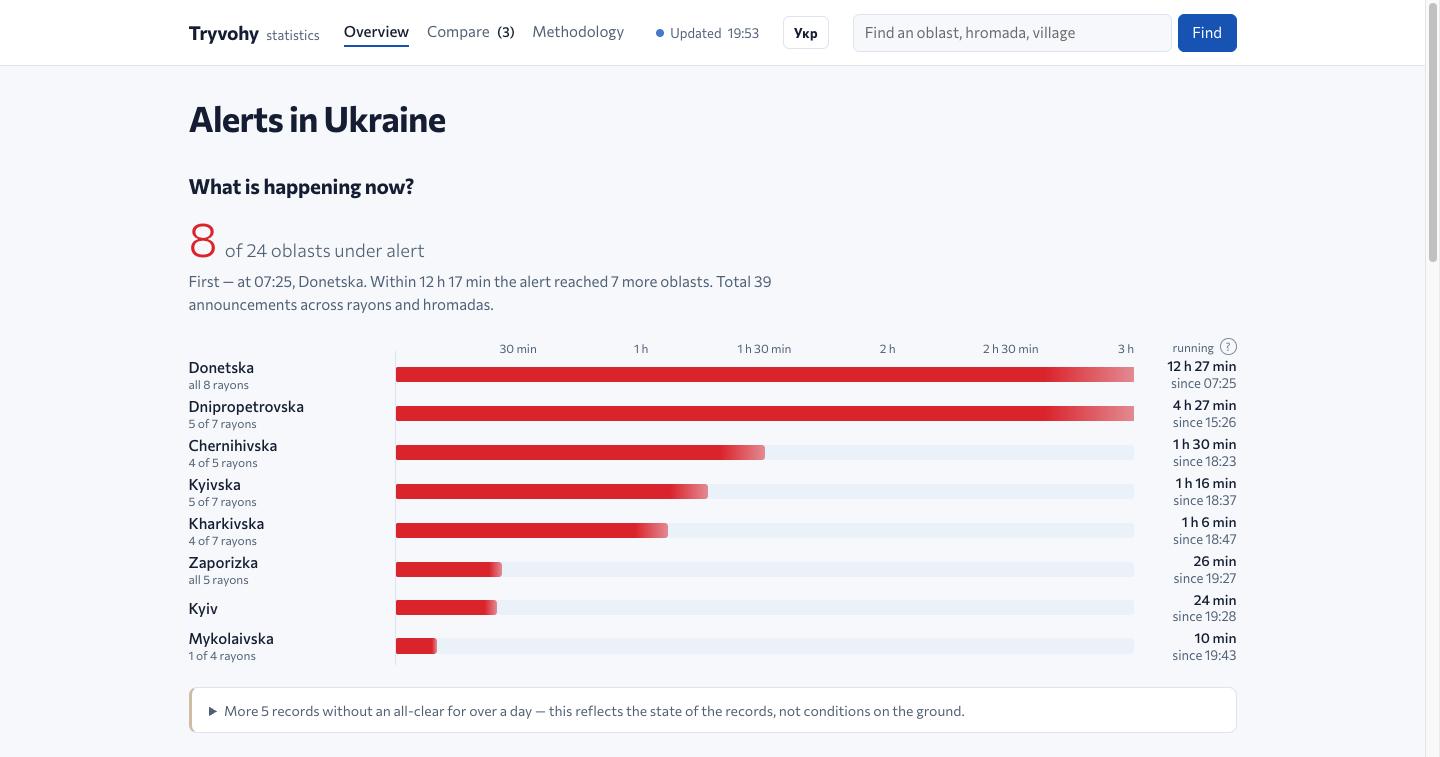
"What's happening right now?" - a live snapshot grouped by region rather than scattered across dozens of duplicate entries (a single alert in the raw data often arrives as a city + community + district all at once).
Why this isn't just "another alert tracker"
The core difference is how the site treats its own limitations. A direct quote from the methodology page:
This is not a notification system. This site describes the past. Make your own safety decisions based on official alert signals, not on these charts.
And further down:
Wherever we don't know something, the page says so. An empty value here is more honest than a plausible-looking one.
This isn't a marketing statement, it's actual functionality. Regions the data source stayed silent about for an entire selected period are shown as a separate block, not as zeros: there's no way to tell "there were no alerts here" apart from "the source simply doesn't cover this territory," so the site honestly says "unknown" instead of quietly defaulting to zero. Periods when the data source itself went down are flagged on every chart they affect, and excluded from duration calculations.
A telling technical detail: if an alert started before the source went down and never got a recorded end before it came back online, it's simply excluded from the duration count entirely - otherwise you'd end up with an alert lasting several days that nobody actually lived through.
The arithmetic that separates an archive from a simple counter
The site's most important rule: alert durations are never added together, they're merged first. An example straight from the methodology:
If six districts were simultaneously under alert at 03:35, that's eight minutes of real time, not forty-eight. One evening in Kyiv Oblast, nine district-level alerts that "summed" to 113 minutes produced two episodes totaling 66 minutes.
Without this rule, any region with multiple districts would show inflated statistics simply because alerts in neighboring districts frequently overlap in time.
Technically, in brief
Data is pulled from two sources - an official API and a Telegram channel archive - every two minutes for current events. Every raw message is stored forever and never deleted, so if a processing bug is ever found, the entire history can be reprocessed from scratch. A message that fails to parse isn't discarded - it waits until the parsing logic is fixed, then gets processed automatically.
Try it
The site is available in Ukrainian and English at tryvogy.com. If you're curious how much time your region, district, or city has actually spent under alert - there's an answer there, and it's honest about it when there isn't one.