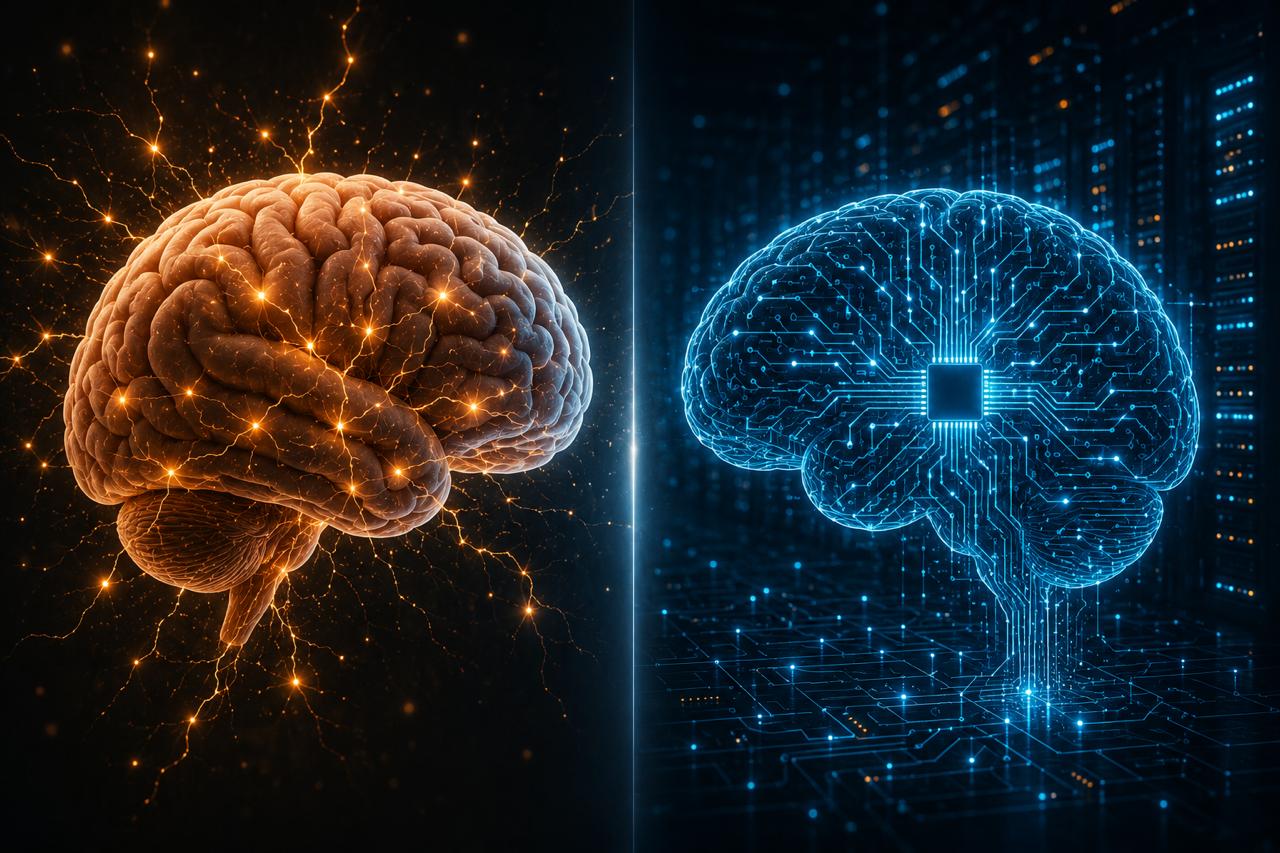
 While you're reading this, your brain is running on about 12-20 watts, roughly the level of a weak light bulb or a phone charger. AI trying to replicate the same brain function in real time would burn through about 2.7 billion watts, according to an estimate from Switzerland's Blue Brain Project. That's the equivalent of three nuclear power plants running simultaneously, just to simulate what happens inside your skull on its own.
I've been interested in this topic for a while, not as a "who wins" competition, but as an engineering question: why did nature find such an elegant solution while we're building something orders of magnitude less efficient - and what's happening right now as engineers try to directly copy that natural architecture in silicon.
How big is this gap, really
The numbers here aren't just large, they're hard to even picture. A peer-reviewed study in Frontiers in Neuroscience estimates the overall relative efficiency of the brain versus silicon processors at roughly 2.7×10¹³ times, twenty-seven trillion. Part of that gap comes from the fact that current hardware simulates biological brain activity about 30,000 times slower than real time, so even if you zeroed out the energy difference, the speed would still lag catastrophically.
Interestingly, the gap in raw compute speed has narrowed lately. In 2026 the El Capitan supercomputer (1.8 exaflops) finally caught up to the brain in raw throughput. But it paid for that with 30 megawatts of electricity versus the brain's 20 watts, a difference of well over a million times.
Where AI wins, and where it still doesn't
It would be unfair to say the brain wins everywhere. AI dominates narrow, well-defined tasks: recognizing patterns across massive datasets, finding correlations across millions of examples, calculations that are simply beyond what a human can do quickly.
But the brain still wins when it comes to generalization and learning from very few examples. A child memorizes a new word or recognizes a new face after one or two exposures. A large AI model needs thousands, sometimes millions, of examples to do the same. That's not a minor detail, it's a fundamental difference in how learning itself works.
The most interesting part isn't competition, it's convergence
Here's what genuinely excites me most: the industry is already directly trying to copy the brain's architecture in silicon instead of just throwing more brute force at the problem.
Traditional AI chips (GPUs, TPUs) work on a principle where memory and computation are physically separated, and every parameter activates for every input, regardless of whether it's actually needed. The brain works completely differently: most neurons stay silent most of the time, firing only when there's an actual signal.
That's exactly the idea neuromorphic chips are trying to implement. IBM NorthPole places memory and computation in the same location, exactly like the brain does, delivering 25 times better energy efficiency than comparable GPU inference for image recognition tasks. The University of Manchester's SpiNNaker 2 scales to billions of artificial neurons specifically for brain simulation and edge AI. This isn't just "a faster chip," it's an attempt to transplant the underlying logic itself into hardware.
And then there's a direct connection - Neuralink
If neuromorphic chips copy the brain, Neuralink takes the opposite approach, trying to directly wire the brain to a machine. As of September 2025, twelve patients with severe paralysis have received implants. The first one, Noland Arbaugh, controls a computer cursor, plays video games, and even plays chess online, all through thought alone, via 1,024 electrodes spread across 64 threads thinner than a human hair.
For 2026, Musk announced a shift to high-volume production and an almost fully automated surgical procedure, with the implant's threads now passing through the dura mater without needing to remove it, which he described as a significant technical step forward.
This isn't abstract futurology anymore. These are real people regaining access, through the dura mater, to a digital world they'd lost after an injury. And this is exactly where the intersection of brain and AI stops being a metaphor or a numerical comparison and becomes a literal physical connection.
And then there's Sam Altman, who sees the brain as a flaw to be fixed
I came across an excerpt from Parmy Olson's book about Altman, and it contains a telling detail that contrasts sharply with everything above. Altman believes the human brain works too slowly, according to him, people learn at about two bits per second, while computers operate at gigabits and terabits. After a series of meditation sessions, he concluded that there's no separate "self" to begin with, and therefore consciousness could, in principle, be uploaded into a computer.
This isn't just philosophical musing, real money is behind it. Altman has invested $375 million in nuclear fusion and $180 million in life-extension research, and paid $10,000 to have his own brain cryopreserved after death.
And here's where it gets genuinely interesting: a person who believes that strong AI will inevitably surpass humanity is, at the same time, preparing for a scenario where that same AI (or a synthetic virus) turns against people, stockpiling weapons, gold, gas masks, and supplies, and keeping a property in Big Sur he could fly to if things go bad.
I see a pretty telling contradiction here. If you genuinely believe the technology you're building will inevitably surpass, and possibly replace, the human mind, why prepare a personal bunker for the scenario where that same technology spirals out of control? It's either an extraordinarily consistent form of caution from someone holding both scenarios in mind at once, or a sign that, on some deeper level, even the builders of the most powerful AI systems don't fully believe their own public predictions.
What I take away from all this
Comparing the brain and AI head-to-head, "which one is smarter", feels like the wrong question to me, and Altman's position shows exactly where that framing leads: if you see the brain purely as a slow, flawed device, the logical next step is wanting to replace or "upgrade" it. That framing doesn't sit right with me.
What's far more interesting to me is what's happening right now at the boundary between these two worlds, without anyone trying to "win." On one side, engineers are learning from the brain, copying its architecture into neuromorphic chips to escape the catastrophic inefficiency of current AI. On the other, technologies like Neuralink are erasing the boundary between "brain" and "machine" altogether, turning the comparison into literal collaboration rather than replacement.
I think that in about ten years, the question "which is more efficient, the brain or AI" will sound as strange as asking today "which is better, legs or wheels." The right answer is most likely a hybrid, where each part does what it does best. And the idea of fully "uploading" yourself into a computer, leaving the body and brain behind as outdated hardware, is a whole different conversation, closer to religion than to engineering.