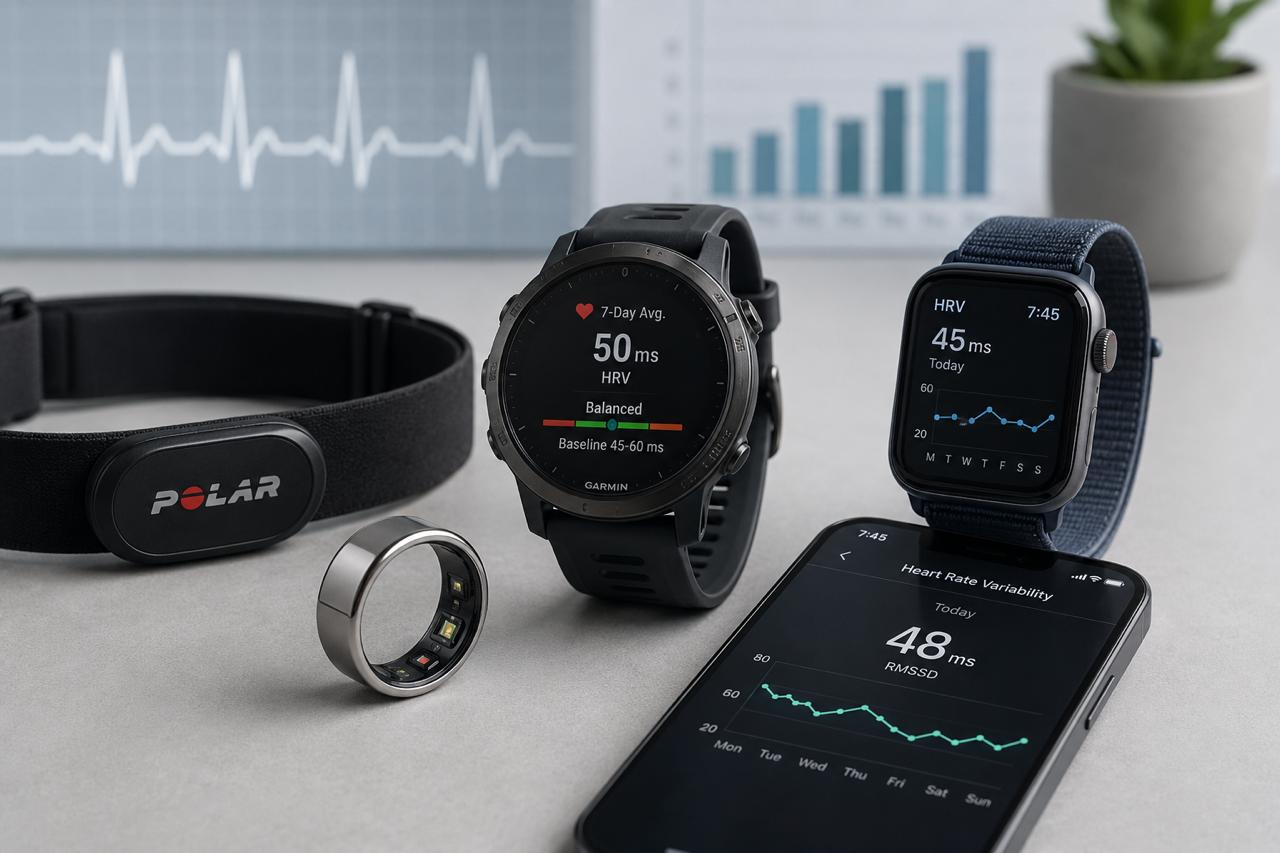
Back in 2020, "consumer wearable HRV accuracy" was mostly a marketing claim with shaky scientific footing. By 2026, after several years of accumulating validation studies, it's become a defensible scientific category - at least partly. Let's figure out exactly where the line sits between real science and a nice visualization layered on top of it.
What HRV actually is
Heart rate variability (HRV) isn't how fast your heart beats, it's the variation in time between successive heartbeats. A healthy heart doesn't tick along like a metronome - small fluctuations between beats are normal, and those fluctuations are regulated by the autonomic nervous system: the sympathetic branch (fight-or-flight) and the parasympathetic branch (rest and recovery).
Higher HRV generally reflects a more adaptable, resilient nervous system state. Lower HRV is associated with stress, fatigue, and inadequate recovery. That's not just a talking point - systematic reviews, including studies of medical professionals in high-stress situations, confirm that HRV changes predictably in response to real physiological load.
The most important 2026 study
The key work that nearly every serious review of this topic now cites is a study by Michael Dial and colleagues at the Human Performance Collaborative at Ohio State University, published in Physiological Reports. Researchers collected 536 nights of simultaneous medical-grade ECG and consumer-wearable data from 13 healthy adults, calculating a concordance correlation coefficient (CCC) for overnight HRV and resting heart rate.
Device accuracy comparison
| Device | Form factor | Error / CCC | Best for |
|---|---|---|---|
| Polar H10 | Chest strap | CCC > 0.99, ±1ms | Maximum accuracy, research-grade reference |
| Oura Ring | Ring | CCC 0.99, ±5-10ms | Passive overnight tracking, no routine needed |
| Garmin | Watch | CCC 0.87 | Sports, training, round-the-clock tracking |
| Apple Watch / Fitbit | Watch | ±15-25ms | Convenience, general monitoring |
| Smartphone camera | Single reading | 85-90% vs chest strap | One-off morning reading under ideal conditions |
The gap between the top and bottom of this table is essentially the gap between a research-grade instrument available to ordinary people for around $100, and a convenient but less precise everyday gadget. Both have their place, they're just built for different jobs.
The key nuance: two very different layers of data
Here's where the Dial study makes the most important point for anyone glancing at their tracker screen each morning: the raw HRV measurement itself (a number in milliseconds, rMSSD) is now a genuinely reliable, validated scientific category, at least for top-tier devices. That's real physiological data.
The proprietary composite scores, on the other hand - Oura's "Readiness Score," WHOOP's "Recovery Score," Garmin's "Body Battery" - are a completely different story. These figures are built on top of raw HRV data using each company's closed algorithms, which combine HRV with other metrics (sleep, body temperature, activity) through formulas that aren't published and haven't gone through independent scientific validation nearly as rigorously as the underlying HRV measurement itself. In other words, trust the number in milliseconds and its trend over time - not the colorful composite score and the pleasant animation wrapped around it.
Does any of this actually mean anything for how you feel
There's a separate 14-day observational study of 41 healthy adults: daily five-minute HRV readings using a Polar H10 chest strap were compared against participants' self-reported sleep, fatigue, and stress. The result - higher RMSSD was statistically significantly associated with better wellbeing: better sleep, lower fatigue, lower stress.
But there's an important caveat: effect sizes were modest, and individual variability was substantial. That means the link is real and scientifically supported, but nowhere near as deterministic or dramatic as some apps' marketing implies with phrases like "your nervous system is in a critical state." In the actual data, it's more of a soft correlation than a hard diagnosis.
What I actually see on my own Garmin
I wear a Garmin mostly for sports and training, but lately I've started paying closer attention to the HRV numbers too, not just distance and pace. Based on my own observations, three things noticeably affect my HRV: bad or insufficient sleep, hard training sessions and runs, and work stress. All three line up neatly with what the science above shows - HRV responds to genuine physiological load, not to something random.
Given that Garmin sits at a CCC of 0.87 in the table above - solid, but not the most accurate device out there - I don't treat the daily number as a precise medical reading. Instead, I watch the trend over a week: if the number stays noticeably below my usual baseline for several days in a row, that's a signal for me to either rest or at least not stack a hard session on top of already-accumulated fatigue. A single dip after a tough run or a bad night's sleep I don't factor in at all - that's exactly the case where the science says to look at the trend, not a single data point.
What to actually do with this
To boil all the evidence down into practical takeaways:
Trust the trend, not the absolute number. One bad morning reading means almost nothing. A consistent drop over a week or two is worth paying attention to.
Pick a device for the job, not the hype. If the goal is maximum scientific accuracy for reasonable money, a chest strap still beats any ring or watch. If the goal is sports and round-the-clock activity tracking, a watch like Garmin is a solid practical trade-off, even if it gives up a bit of pure accuracy.
Treat composite "readiness scores" as a convenient nudge, not a medical verdict. Raw HRV milliseconds carry scientific weight. A colorful "72 out of 100" with a recommendation attached to it is a product of a company's marketing department, not a separately validated medical study.
Don't panic over single fluctuations. HRV naturally shifts based on countless factors - alcohol the night before, a bad night's sleep, ordinary daily stress. That's normal physiology, not a reason to worry every time the number is lower than yesterday's.