OpenAI has opened full access to the GPT-5.6 family, the flagship Sol, the balanced Terra, and the cheapest Luna. The rollout is happening across ChatGPT, Codex, and the API globally at once, and is expected to take up to 24 hours from the start. The main thesis of this release isn't record-breaking benchmark scores, it's more useful work per dollar and per token spent.
Three durable capability tiers instead of one model
The key architectural idea of this release is decoupling the version number from the capability level. The number 5.6 marks the generation, while Sol/Terra/Luna are "durable" capability tiers that can now each update and evolve at their own pace, without waiting for a synchronized release of the entire lineup. Essentially, OpenAI adopted the same principle Anthropic used with the Fable/Mythos pair, separating "generation" and "model class" into two independent dimensions.
Access was rolled out unevenly across tiers. In regular ChatGPT, Sol is available to Plus, Pro, Business, and Enterprise users through medium and high "effort" levels, while Pro/Enterprise additionally get Sol Pro for the hardest tasks. In ChatGPT Work and Codex, the free Free and Go tiers get a full Terra for the first time instead of a stripped-down model, arguably the most notable access policy change in the past year.
Pricing and caching - there's an interesting detail here
API pricing per million tokens: Sol - $5 input / $30 output, Terra - $2.5 / $15, Luna - $1 / $6. For comparison: Opus 4.8 costs $5/$25, and Fable 5 costs $10/$50.
What's technically more interesting than the price itself is the change to prompt caching mechanics. Explicit cache breakpoints have appeared, the minimum lifetime of a cache entry is now fixed at 30 minutes, and writing to cache now costs more than a regular input token, 1.25 times the uncached rate. Reading from cache kept the standard 90% discount. In practice this means: if you're running a short-lived agentic workflow with frequent but brief sessions, the benefit of caching may end up smaller than before, it's worth recalculating your prompt economics if you rely heavily on system-prompt caching.
Programmatic Tool Calling - the main technical novelty
This is, in my view, the most interesting engineering detail of the release. The Responses API now supports writing and running lightweight in-memory programs that coordinate tool calls themselves, filter intermediate data, and decide the next step without sending every intermediate result back to the model through a separate round trip.
In practice this means fewer tokens and fewer model "turns" on tool-heavy tasks. At Rogo (financial research agents), this produced 24% fewer output tokens and 28% faster execution at the same quality. At PlayCo (building Unity scenes through a structured API), 63.5% fewer tokens and 50.1% fewer model turns compared to direct tool calls. An important detail for anyone working with Zero Data Retention: Programmatic Tool Calling is compatible with ZDR mode, meaning intermediate data never leaves execution memory.
Multi-agent and ultra mode
ultra is a new top capability tier: by default it coordinates four parallel agents that explore different approaches to a task simultaneously, then the system synthesizes the final result. In tests on BrowseComp and SEC-Bench Pro, OpenAI also showed configurations with 16 agents, the quality/time curve shifts up and to the left in that case, meaning a better result in less time, not just a linear scaling of cost.
Across products, ultra is available selectively: in ChatGPT Work, only Pro and Enterprise; in Codex, from the Plus tier up. In the API itself, developers get the same mechanism through a multi-agent beta in the Responses API, you can spin up parallel sub-agents and get a synthesized result in a single request.
Benchmarks: where Sol genuinely leads, and where it doesn't
Now for the numbers from OpenAI's official table, and here it's worth looking closely, because the picture isn't uniform.
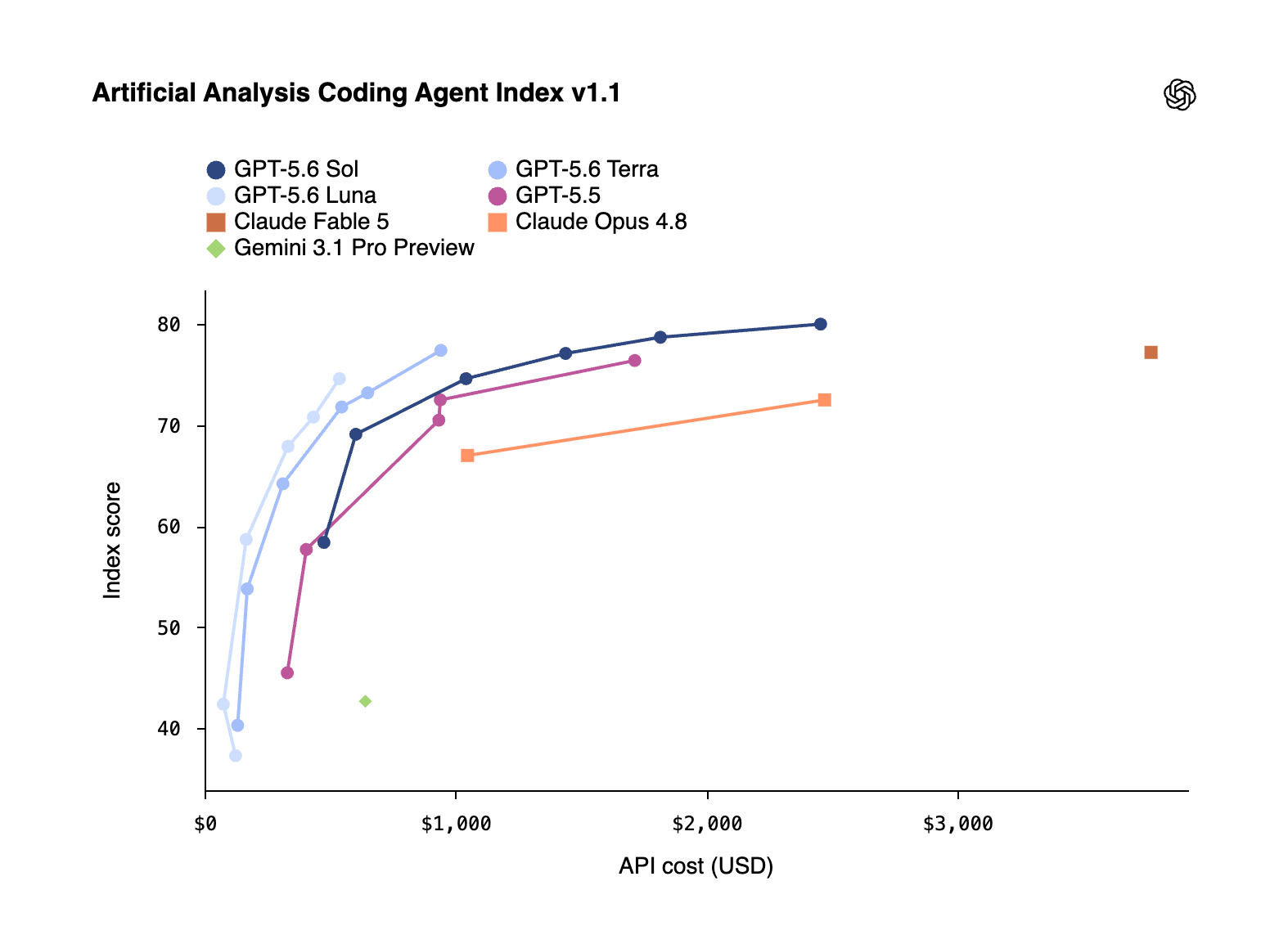
Agentic coding. On the Artificial Analysis Coding Agent Index v1.1, Sol scored 80 versus 77.2 for Fable 5 and 72.5 for Opus 4.8, and did so, according to OpenAI, using less than half the output tokens and at roughly a third of the cost.
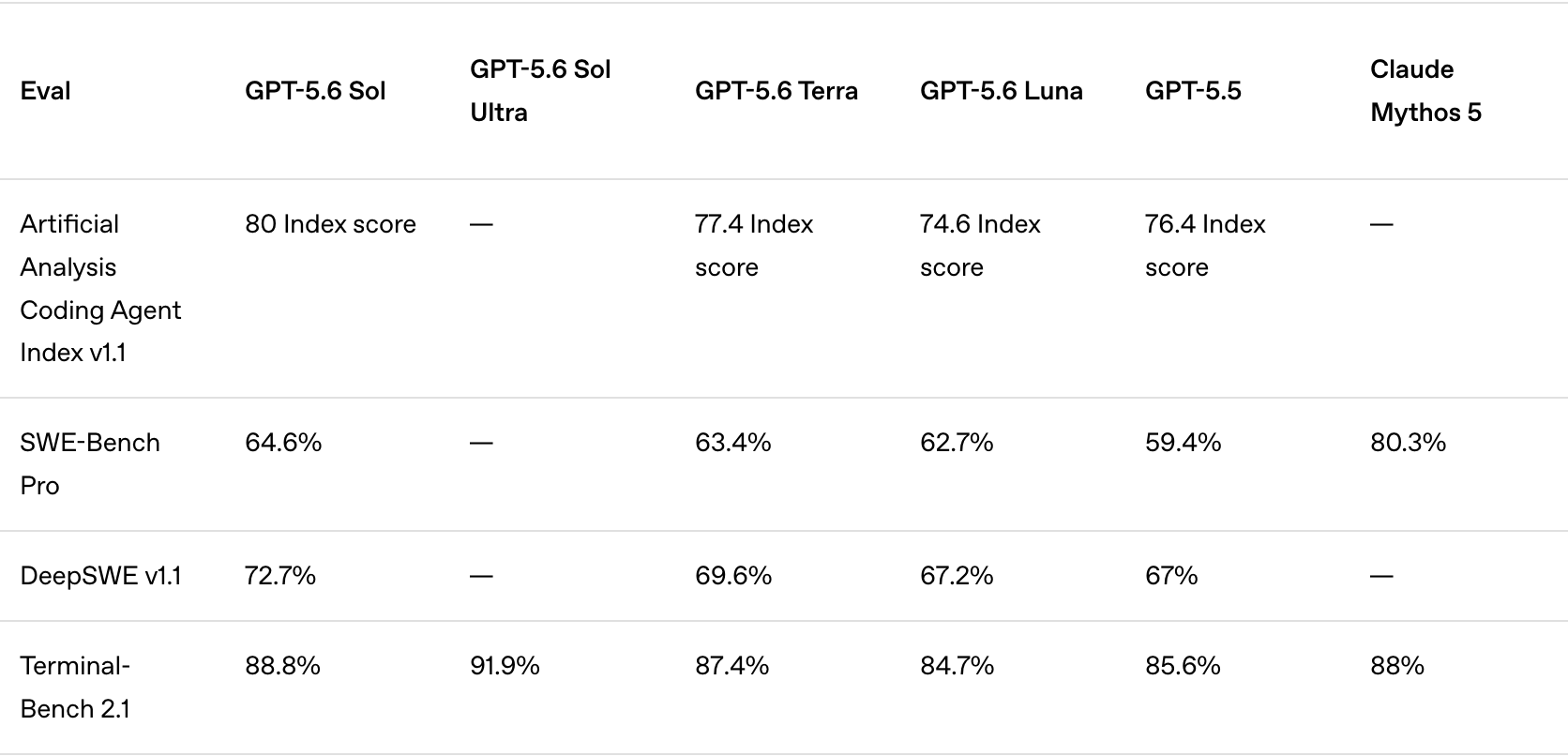
Real engineering work. Here the picture flips: on SWE-Bench Pro, Sol scored 64.6%, less than Fable 5 (80%) and especially Mythos 5 (80.3%). Even the cheapest tier, Luna (62.7%), lags both Anthropic models on this test by nearly 17-18 points.
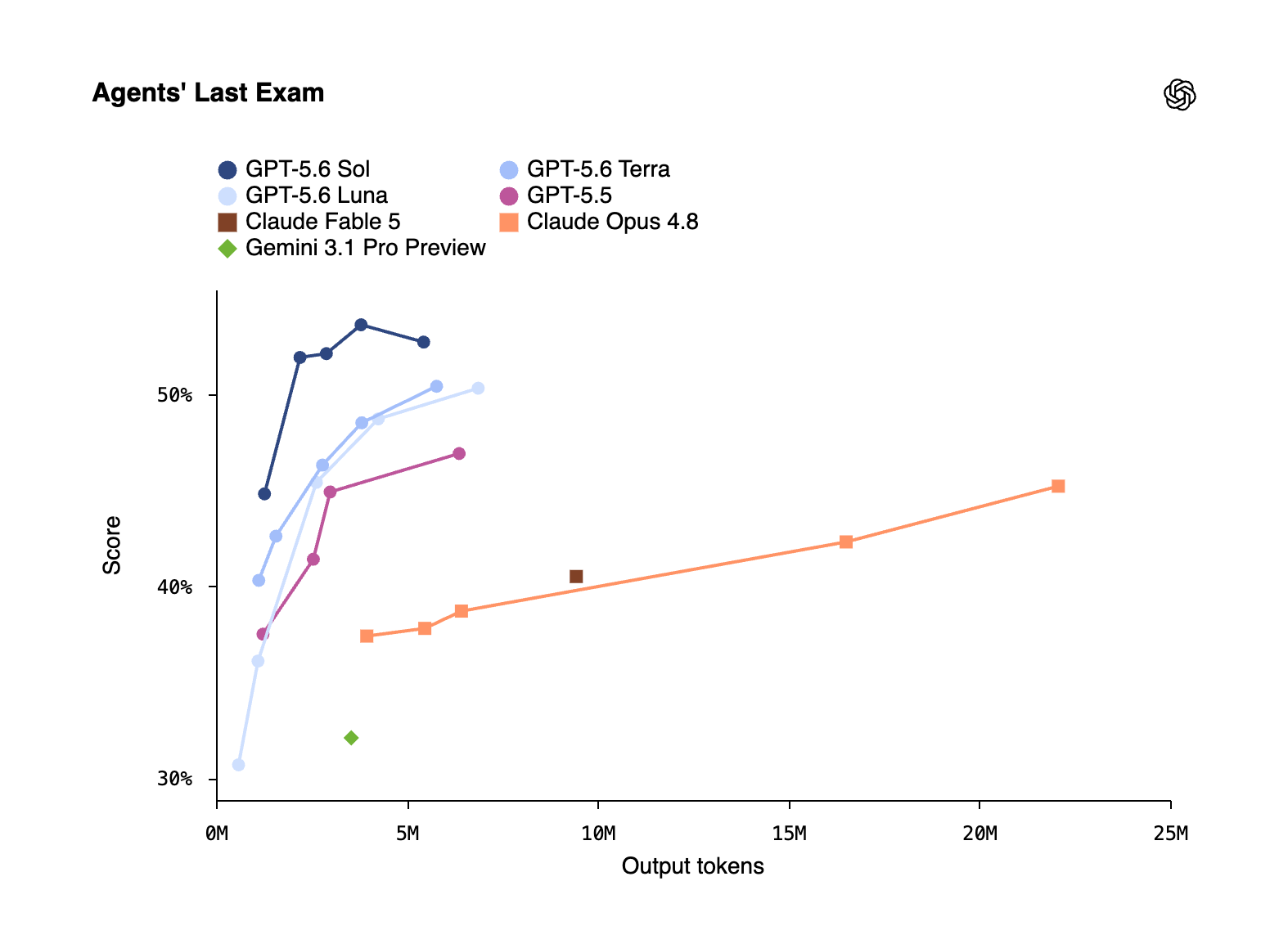
Long professional workflows. On Agents' Last Exam, a test of long-horizon workflows across 55 industries, Sol comes out ahead with 52.7% versus 40.5% for Fable 5 and 45.2% for Opus 4.8. At the maximum reasoning level, OpenAI claims an even bigger gap, 53.6 versus 40.5 (a 13.1-point difference by their scoring methodology).
Math. On FrontierMath Tier 4 (the hardest level), Fable 5 outpaces Sol: 87.8% versus 83%. On Tier 1-3 the situation reverses: Sol scores 89%, OpenAI hasn't published Fable's numbers for this tier.
Cybersecurity. This is where Sol shows the biggest jump over its predecessor: ExploitBench, 73.5% versus 47.9% for GPT-5.5; ExploitGym, nearly doubling its peak score (from 15.1% to 24.9% at two hours, up to 33.7% at six hours); SEC-Bench Pro, 71.2% versus 45.8%. But compared to Claude Mythos 5 on ExploitBench, Sol still trails: 73.5% versus 78%.
Cybersecurity: a reasoning monitor and a passport for access
This is the second release in a row (after Anthropic's Fable 5 and Mythos 5) to go through prior clearance with the US government, initially only vetted partners had access, and the full opening was finalized only just before the general release.
Technically, the protection system is built in several layers: safety trained into the model, real-time checks on top of that, plus monitoring and account-level controls. Notably, OpenAI added a "reasoning monitor," a separate layer that analyzes the entire conversation context for potential harm rather than relying solely on classifier filters (a classic industry weak point, in their words, is that the "block or not" decision gets made by a less capable classifier model that's hard to update quickly).
The most sensitive cyber capabilities are available only through Trusted Access for Cyber, an identity verification process. Starting September 1, keeping access to the most powerful cyber models will require a hardware passkey (Advanced Account Security); anyone who doesn't set it up in time will automatically get a reduced default access level. Before release, the system went through roughly 700,000 hours of automated red-teaming on A100e GPUs.
What early partners are saying
Cursor president Oscar Schulz called GPT-5.6 one of the strongest models they've tested on CursorBench. Qodo CEO Itamar Friedman noted roughly three times fewer tokens on PR reviews with a better F1 score compared to GPT-5.5. And Notion co-founder Simon Last described Terra as a model that punches above its price, according to him, plenty of agents running on GPT-5.5 hit the same result on Terra at half the cost and using 16% fewer tokens.
Bottom line
GPT-5.6 doesn't claim outright leadership across every task: on real engineering work (SWE-Bench Pro) and the hardest math, Fable 5 and Mythos 5 remain stronger. But the architecture of the release itself, three independent capability tiers, Programmatic Tool Calling for cheaper agentic workflows, explicit cache control, and parallel agents in a multi-agent beta, looks like an attempt to compete not on benchmark scores but on the cost of engineering work at scale. And free Terra in ChatGPT Work and Codex is possibly the most practical consequence of this release for most developers.