SpaceXAI (the company formerly known as xAI, now officially merged with SpaceX) has opened public access to Grok 4.5. The model became the default in the Grok Build agent, showed up free for a limited time in Cursor across all tiers, and is available to developers via API at $2 per million input tokens and $6 per million output tokens.
Cursor at the foundation of the model
The main detail of this release is Cursor's role in training. Grok 4.5 is built on a new base model, V9 (1.5 trillion parameters), and Cursor data went into the additional training, the editor's team participated in the SFT and RL stages. SpaceX gained access to this data and to the engineers through the acquisition of Anysphere (Cursor's developer) for $60 billion, a deal expected to close in Q3. RL training covered hundreds of thousands of tasks with a focus on multi-step development.
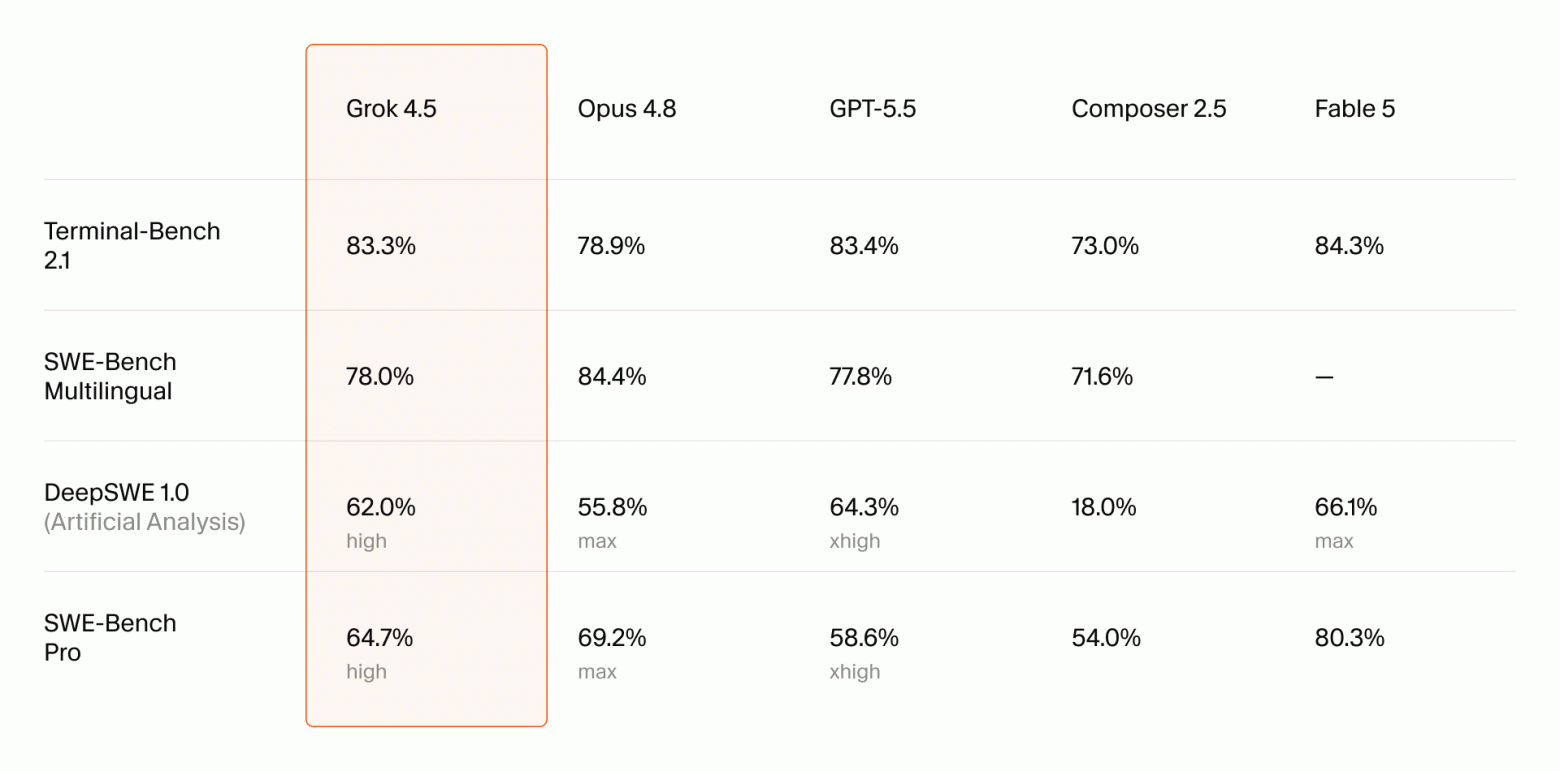
An honest benchmark - a rarity for the industry
And here's what's genuinely interesting: in its own announcement, SpaceXAI didn't paint Grok 4.5 as the leader on a single one of five tests. On four out of five, DeepSWE 1.0, DeepSWE 1.1, Terminal Bench 2.1, and SWE Bench Pro, Fable (max) came out ahead, Anthropic's flagship a class above Opus. Musk's claim of "Opus-level" holds up only partially: Grok 4.5 beats Opus 4.8 on Terminal Bench 2.1 (83.3% vs 78.9%) and DeepSWE 1.0 (62% vs 55.8%), but loses on DeepSWE 1.1 and SWE Bench Pro, roughly a 2:3 score.
For an industry where vendors typically publish only the benchmark slices that favor them, this kind of openness is unusual and genuinely deserves credit.
Musk himself wasn't hiding his ambitions even before the release. Announcing the model on his X account, he wrote that it's an Opus-class model, but faster, more token-efficient, and cheaper.
The bet isn't on records, it's on economics
The real argument of this release isn't the benchmarks, it's the cost per unit of intelligence. The model runs at 80 tokens per second, and solves a typical SWE Bench Pro task using an average of 15,954 output tokens, 4.2 times fewer than the 67,020 tokens Opus 4.8 uses. SpaceXAI calls this "the most intelligence per unit of time and money."
For price comparison: Opus 4.7 costs $5/$25 per million tokens, GPT-5.6 Sol costs $5/$30, and Grok 4.5 costs $2/$6. So even if the model doesn't always win on quality, the order-of-magnitude price difference can justify the choice for routine tasks.
Where you can already try it
At launch, Grok 4.5 is available primarily to developers, it's not yet in the regular chat at grok.com, but it's already in Grok Build and free (for a limited time) in Cursor. In the EU, the model is promised closer to mid-July, a familiar pattern for major releases lately, where regulation doesn't catch up right away.
The Grok 4.5 release coincided with OpenAI's preparation of GPT-5.6, so the fight for developer attention this summer clearly isn't slowing down.