How I Adapted to Claude's 5-Hour Usage Limit
Claude's message limit isn't counted by the clock, it's counted from the moment of your first message in a session. Send one at 9:00 and the limit resets at 14:00. Send one at 14:30 and you get a fresh window until 19:30. Simple mechanic, but it completely changes how you should plan your workday if you rely on Claude a lot.
The problem I didn't notice right away
I wake up, and the first thing I do is open my laptop or phone and send Claude something work-related. Sounds logical enough. But while I have breakfast, get ready, commute to work, an hour or two just slips by. And that whole time drains out of my 5-hour window while I'm not even using it.
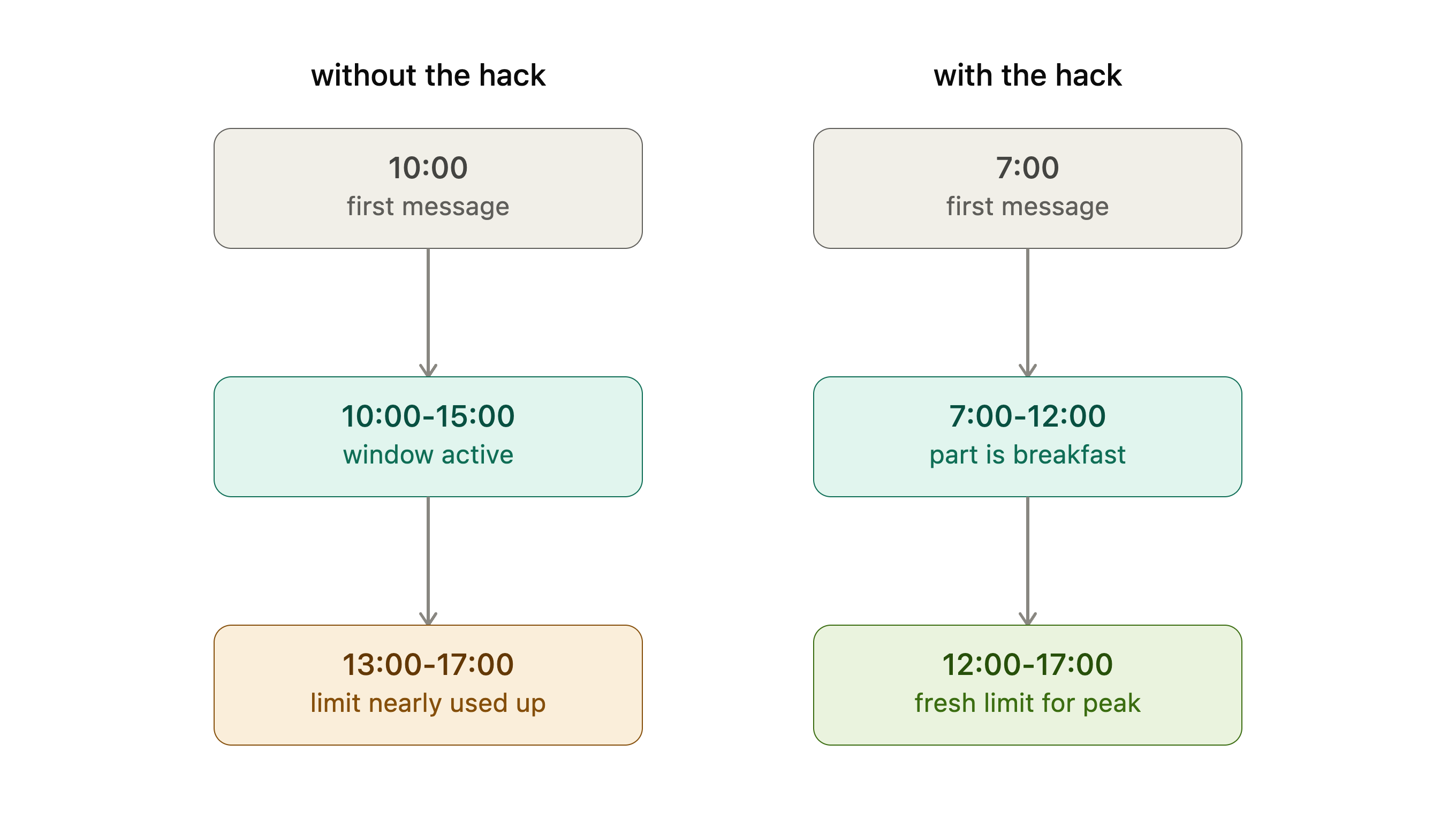
The result: my actual active work with Claude would start around 10-11, and by then the limit was already set to reset around 14-15. So the most productive stretch of the day, lunch and right after, was exactly when I'd hit the ceiling, right when Claude was most needed.
What I changed
Now I deliberately send the first message early, literally right after waking up, before breakfast. Something as minimal as "start the session" or even a single word. The point is just to start that same 5-hour clock as early as possible.
Then I go have breakfast, get ready, commute to work, and all that time that's "useless" to Claude just ticks away on the clock instead of eating into my actual active use. By the time I actually sit down to work, the window has already burned through half of itself on its own.
Why this works
The logic is simple: the limit is a fixed stretch of time, and it doesn't matter whether you're messaging Claude every minute during that time or staying completely silent. The clock keeps running either way. The only question is when it starts, whenever you want it to, or whenever it happens to be convenient to send that first message.
By shifting the timer's start to the earliest possible point in the day, I lined up the reset with the time I actually need it, lunch, the afternoon, when the real work is in full swing.
Why the limit runs out so fast in the first place
The limit isn't counted by number of messages, it's counted by how many tokens Claude processes at once. And a few things eat through that budget much faster than you'd expect:
Large chunks of code. If you drop a whole file with a few hundred lines on Claude, or ask it to rewrite a big module, that's a solid chunk of your limit in a single message, not ten short questions.
Long conversations in one chat. Claude re-reads the entire conversation history on every new message. So by message 20, you're not just paying for that message, you're paying for all 19 before it again. A long chat is an expensive chat, even if each individual message is short.
Heavy tasks that use tools. Web search, working with files, code generation with execution, all of that adds tokens on top of the plain text response, since Claude processes every tool call's results as part of the context.
Attached files and documents. If you keep re-uploading the same file into chat instead of putting it in a Project, you get charged tokens for it again every single time.
The model's selected power level. Harder tasks with a higher thinking effort, or heavier models, burn through the budget faster than short, simple answers.
That's why on days when I'm doing something heavy, a big refactor, a long debugging session, the limit gets used up in an hour or two instead of spreading evenly across all five hours. Which is another argument for shifting the window's start to the morning: when you know the day is going to be heavy, it's better for the window to have already burned through some of its budget on an empty morning message than to run out during the hardest part of the work.
What I ended up with
Now I hit the ceiling at the worst moment much less often. The morning "empty" message costs me a few seconds, and in exchange I get a reset limit exactly when I need it, not whenever it happened to land by accident.
It's a small thing, but small things like this are what working with a tool you use every day is made of. If you also work with Claude actively throughout the day, it's worth paying attention to when your first request actually starts, because that moment determines when your next "empty" stretch will land.