How Chess Taught Me to Think in a Way AI Still Can't
I knew the basic rules of chess since childhood - my dad and grandpa showed me how the pieces move. That's where it stopped, though. I'd occasionally play with friends, but it never really clicked. Just another board game.
Everything changed when a colleague at work suggested a game during a break. I can debug code for hours, but I lost that game in 15 moves - and somehow it hit harder than it should have. After that game, I started taking lessons with a coach. If I was going to lose, I figured I might as well understand why.
For the first few months I only played online - convenient, nobody sees how long you're staring at the most obvious move. Then my coach said, "let's play an offline tournament at a local school." I thought, sure, same thing, just a real board. Naive of me.
Playing offline against a real person turned out to be a completely different sport. No premoves, nobody suggests the best move, just you, the board, the clock, and a person across from you who looks like they've already won. Getting a rating just by showing up didn't work - I actually had to learn to play, not fake it.
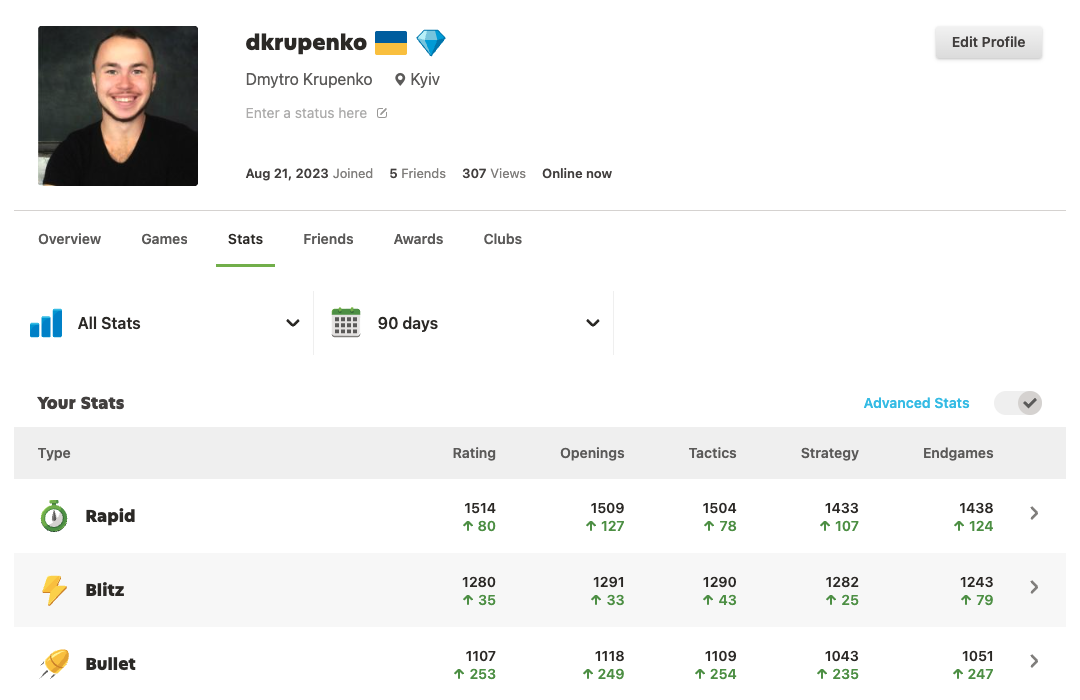
These days I play fast games (5+3, 3+2) and bullet (1+1) on chess.com, and I have an official rating on FIDE. The more I play, the more I notice how it bleeds into my work as a developer and team lead.
Fast chess trains you to decide when there's no time left
In classical chess, you get hours per game. In bullet, you get one minute for the whole thing. Calculating 10 moves ahead just isn't possible there unless you're Magnus Carlsen or Hikaru Nakamura. And since I'm neither of them (shocking, I know), I have to decide fast and accept it won't be perfect.
Sound familiar? It's basically a production incident at 3 AM. Or a client call: "everything's down, fix it now." There's no time to analyze everything - only time to quickly size up the situation and do something.
Bullet trains exactly that: making decisions with missing information, under time pressure, and living with the outcome without a chance to double-check it.
Recognizing patterns instead of calculating everything
A beginner tries to calculate every possible move. An experienced player just recognizes the position: "I've seen this before, this plan usually works here."
Same thing in development. A junior reads every line of new code from scratch. A senior looks at the structure and says: "this is a Repository Pattern with a leaky abstraction" or "classic N+1 query, I've seen this exact thing twenty times."
Chess trains exactly this - recognizing familiar patterns instead of brute-forcing every option. When I look at a new project or someone else's code, I catch myself doing the same thing I do when I evaluate a position: big picture first, details after.
The most important skill: living with your own decisions
This is where AI still loses to a human, both at the board and in code. It doesn't carry the consequences of what it decides.
In chess, once you move, you can't take it back (no premove, the thing offline tournaments painfully lack). You watch your decision play out over the next moves, and you learn from your own mistake because it's yours. That changes how you think about decisions - not "what's theoretically correct," but "what consequences am I willing to live with right now."
Same in development. AI can spit out an architectural decision in a second. But debugging at 2 AM why a "perfect" microservice took down half the system because of a bad retry policy - that's still on a human. That kind of ownership only comes from practice. Your own, not delegated.
Why this matters even more now that AI writes code
Here's the paradox: the more routine work AI takes over, the more valuable it becomes to:
- quickly assess a situation and decide, even with incomplete data;
- recognize a familiar problem structure instead of drowning in details;
- own an architectural decision and be able to explain it;
- stay calm when something breaks and there's no time to spare.
These are exactly the things I've been training at the board for years, long before I ever thought about it consciously. AI is great at "write a function that does X." It's much worse at "decide under uncertainty and take responsibility for it." That's the actual day-to-day job of an engineer, especially once you're also managing a team.
What I'd suggest
You don't need to become a chess player to build these skills. But if you already have a hobby that forces fast decisions under pressure with immediate feedback on the outcome - hold onto it. For me it's chess: from failed childhood attempts by my dad and grandpa to real tournaments and bullet games on chess.com and a rating on FIDE. For someone else it might be poker, esports, or orienteering.
The main point: as AI takes over the routine stuff, the human edge shifts toward things that are hard to automate. Making fast decisions under pressure is one of them. And a chessboard turned out to be a surprisingly good training ground for exactly that.